
Consumers make high-stakes decisions based on what they can see and understand from a product detail page (PDP). For items like apparel, furniture, or housewares – where tactile evaluation and physical inspection are impossible – clear, detailed information about product materials and care requirements becomes central to decision-making.
Yet across many e-commerce platforms, this information is either absent, vague, or buried deep within unstructured content. This gap not only undermines user confidence user confidence at critical moments in the purchase funnel but also triggers a leads to a chain of negative business outcomes of negative business outcomes: elevated return rates, lower customer satisfaction scores, and potential compliance risks under evolving product transparency regulations.
This article outlines why specific and detailed product composition and maintenance information is essential for online retail success. It explores the behavioral and commercial consequences of neglecting this content, then offers a data-backed framework and checklist to help teams design PDPs that support confident, informed purchases.
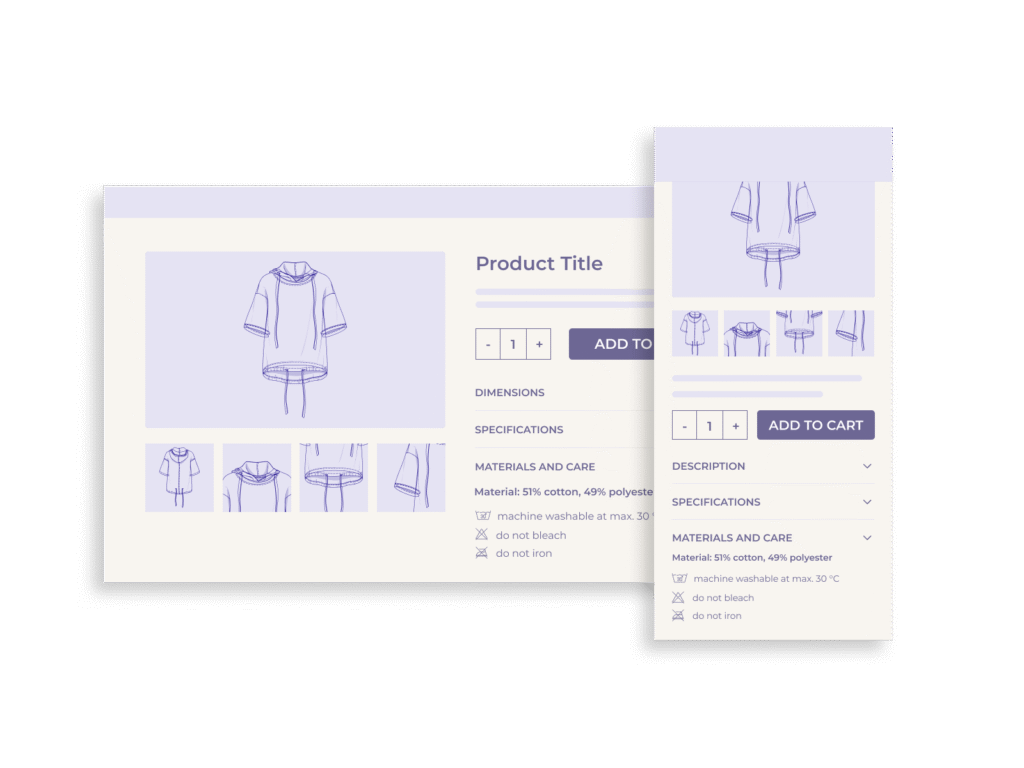
The Hidden Costs of Inadequate Product Details
While a minimalist approach to PDPs may seem user-friendly, leaving out detailed material and care content leads to tangible losses. In usability testing across consumer categories (particularly apparel, home goods, and furniture) 88% of users actively looked for product composition or maintenance instructions before completing a purchase decision. When this information was generic, incomplete, or entirely missing, participants expressed hesitation, frustration, or completely abandoned the product.
From a business perspective, these content failures manifest in three critical ways:
Increased Return Rates
When customers are surprised by the actual feel, durability, or maintenance of a product post-purchase, returns become inevitable. For instance, a buyer expecting a machine-washable cushion cover may be disappointed to find it requires dry cleaning. These misunderstandings could have been prevented with transparent care instructions at the point of purchase.
Negative Reviews and Reduced Repeat Purchases
Unclear or incomplete information around materials or care are frequently cited in negative customer reviews. Phrases like “not as described,” “too delicate,” or “hard to clean” reflect unmet expectations due to informational gaps. Each poor review not only damages future conversion potential but also undermines brand credibility, especially in verticals where quality and performance matter.
Regulatory Compliance Risks
Depending on the region and product type, failing to disclose sufficient material information can trigger legal complications. Textile labeling laws, environmental disclosure requirements, and allergy risk mandates all hinge on adequate product transparency. Noncompliance – even if unintentional – can result in penalties, recalls, or reputational damage.
What Shoppers Actually Expect
Modern online shoppers are not merely browsing; they are evaluating. Their expectations have evolved alongside growing concerns around sustainability, allergy sensitivities, product longevity, and ethical sourcing. As a result, product material and care information has shifted from a “nice to have” to a central component of purchase validation.
In usability studies, participants actively actively looked for detailed specifications, especially when shopping for products expected to endure wear and frequent use. For example, a parent considering a new couch looked for indicators of stain resistance and machine-washable covers, while a fitness enthusiast scrutinized technical fabrics for breathability and moisture-wicking properties. In these cases, general phrases like “durable fabric” or “wash with care” fell short of users’ needs.
Key Shopper Expectations Include:
Material Composition by Percentage: Users want to know exactly what the product is made of – e.g., “80% recycled polyester, 20% spandex” – not just broad terms like “stretch fabric” or “cotton blend.”
- Functional Attributes Linked to Materials: Shoppers interpret material types as clues for durability, comfort, waterproofing, and breathability. For instance, “Gore-Tex” signals waterproofing, while “linen” suggests lightweight breathability.
- Care Requirements Aligned to Use Case: If a product will be heavily used, such as kitchen textiles or children’s clothing, users want assurance that maintenance is simple and practical. Instructions like “machine wash cold, tumble dry low” provide clarity, while vague references to “gentle cleaning only” raise doubt.
- Clear Allergy or Sensitivity Warnings: In categories such as jewelry, cosmetics, or textiles, users seek disclosures on materials that may cause allergic reactions (e.g., nickel content in earrings or latex in gloves).
- Environmental and Ethical Transparency: A growing segment of shoppers, particularly millennials and Gen Z, expect material disclosures to reflect sourcing ethics (e.g., organic cotton, vegan leather, recycled plastic) and sustainability.
When shoppers do not find this information (presented clearly, concisely, and in context), they either pause their decision, bounce to a competitor, or rely on guesswork that can lead to dissatisfaction later. Inversely, providing well-structured and trustworthy material and care data leads to greater conversion confidence and reduced cognitive friction.
Best Practices for Material and Care Information
The delivery of material and care information must balance clarity, comprehensiveness, and usability. When done correctly, it becomes a conversion asset, empowering users with the confidence to purchase and care for the product long-term. Below are best practices distilled from user behavior research and industry standards.
Always Include Both Material and Care Information – Not Just One
It’s not enough to say what a product is made of; shoppers also need to know how to maintain it. Leaving out either side of this equation leaves users with an incomplete picture. A cotton dress that is “dry clean only” has a very different value proposition from one that is machine-washable, even if both are made from similar textiles.
Be Specific, Not Generic
Generic descriptors like “soft material” or “easy to clean” frustrate and confuse users. Instead, specify:
- Material Example: “100% Egyptian cotton (OEKO-TEX® certified)”
- Care Example: “Machine wash cold on gentle cycle. Tumble dry low. Do not bleach.”
Specifics are especially important for multi-material items (e.g., furniture with mixed fabric and wood components) or items with performance properties (e.g., “UPF 50+ rated swimwear”).
Use Bulleted Lists Under Clear Headers
Testing shows that bulleted formatting significantly improves scannability, especially for dense technical content. Break out “Material” and “Care” into their own clearly labeled sections within the PDP, ideally in the main product details tab.
Avoid Linking Off-Page or Using External Manuals
Product care content should be presented inline, not through links to manufacturer PDFs or external FAQs. Shoppers consider care information to be core product data – redirecting them adds unnecessary friction and suggests a lack of transparency.
Dynamically Update Material/Care Info for Variant Selections
If product variants (e.g., different fabrics, colors, or models) come with different materials or care instructions, the PDP must dynamically reflect these differences in real time. A user selecting “Leather – Brown” should see care guidance specific to that variant, not generic info shared across all versions.
Support Accessibility and Jargon-Free Language
Use clear, non-technical terms where possible, and supplement industry-specific language with tooltips or “hover to explain” icons for added clarity. For instance, not all users will understand “tencel” or “polyamide” without context.
Highlight Functional Benefits in Material Descriptions
Where applicable, connect materials to performance: “Water-resistant thanks to polyurethane-coated outer shell” or “Naturally antimicrobial bamboo fabric.”
Implementing these practices not only elevates PDP usability but also aligns with growing consumer demands for product clarity, sustainability, and longevity.
Implementation Challenges and Solutions
While the importance of detailed material and care information is clear, many e-commerce teams struggle with implementing these standards at scale. Large and varied product catalogs, inconsistent supplier data, and legacy CMS limitations often create friction in operationalizing content quality. This section outlines common challenges – and practical solutions – to overcome them.
Challenge 1: Inconsistent or Missing Supplier Data
Many brands rely on third-party manufacturers or dropshippers, who may provide incomplete or inconsistent data on materials and care instructions. This makes it difficult to standardize product information across the catalog.
Solution:
Establish a data intake protocol with suppliers that requires structured, product-level material and care fields. Use standardized templates or onboarding forms that ensure critical attributes are not left out. Where full automation isn’t practical, prioritize high-volume or high-return SKUs for manual enrichment by in-house content teams.
Challenge 2: Difficulty Standardizing Across SKUs and Categories
Some teams face friction aligning content standards across varied product categories, especially when care expectations differ dramatically (e.g., kitchenware vs. textiles).
Solution:
Develop a taxonomy-driven content model. Use product type metadata to assign content rules: for example, every “Upholstered Furniture” SKU must include fabric type, filling material, and cleaning instructions. This approach allows scalable content enforcement while respecting category-specific requirements.
Challenge 3: PDP Template Limitations
Legacy PDP templates may not support separate headers or dynamic content updates, forcing teams to bury material and care information deep within generic product descriptions.
Solution:
Invest in componentized PDP design, where material and care blocks are reusable modules with clear schema tags. This allows both editorial control and programmatic scalability. Implement variant-aware rendering, so selecting different options (e.g., leather vs. fabric) automatically updates the material and care sections in real-time.
Challenge 4: Jargon and User Comprehension Barriers
Even when detailed, material descriptions can overwhelm users if they rely on technical jargon or lack contextual cues.
Solution:
Use plain language best practices and add layered content aids such as tooltips, glossaries, or hover-over explanations for uncommon terms (e.g., “Modal,” “TPU,” “Jacquard weave”). User-test these terms for clarity to avoid misinterpretation.
Challenge 5: Time-to-Market Pressures
Under tight launch schedules, detailed product content often becomes an afterthought. As a result, PDPs go live with placeholder or generic information.
Solution:
Integrate content QA into the product launch workflow. Use automated rules (e.g., flag any apparel PDP missing care instructions) and content readiness dashboards to ensure all required attributes are complete before go-live.
Checklist – Material and Care Info Excellence
To ensure your product detail pages meet user expectations and minimize risk across your catalog, use the following checklist as a cross-functional audit and implementation guide. This can be applied by content strategists, merchandising teams, UX designers, and e-commerce managers alike.
Strategic Content Requirements
- Every relevant product includes both material and care information
- Descriptions are specific, not generic (e.g., “100% organic cotton” vs. “cotton blend”)
- Material and care sections are clearly labeled and easy to locate
- Details reflect variant selections (e.g., color, finish, size)
- Functional benefits tied to materials are called out (e.g., waterproof, hypoallergenic)
UX & Presentation Best Practices
- Content is structured using bullet lists under descriptive headers
- No links to external PDFs or manufacturer pages for care info
- Terminology is plain and user-friendly, with tooltips for technical terms
- Supports accessibility (screen reader compatibility, semantic HTML)
- Optimized for mobile display (expandable sections, touch-friendly swatches)
Data and Workflow Integrity
- High-risk SKUs (e.g., high returns or sensitivities) receive extra scrutiny
- Suppliers provide structured material/care data at onboarding
- Product taxonomy maps to category-specific content rules
- CMS/PIM supports dynamic updates and variant-aware content blocks
- QA workflows ensure material/care info is complete before launch
By institutionalizing this checklist within your product content lifecycle, you can close the gap between user expectations and real-world product experiences. Doing so not only reduces returns and negative reviews but also builds lasting trust and brand equity.
Conclusion
The quality of your product detail pages directly impacts your bottom line. Material and care information is no longer a peripheral detail; it is a core element of digital merchandising, user experience, and operational efficiency.
As demonstrated across behavioral research and business performance metrics, leaving out or generalizing this information undermines customer trust, increases return rates, and exposes brands to compliance risks. On the other hand, providing accurate, complete, and context-specific material and care data transforms uncertainty into confidence – a critical factor for high-conversion PDPs and long-term customer satisfaction.